
The small RNA paper is completed and out for early access! Find it here.
After graduating last June, I hightailed it to my new position at the University of Texas at Austin, where I was pretty sure I had moved as far away as possible from National League baseball. Since the the poor hapless Astros were shifted to the American League last year, my best hope to see a Giants game would have to be interleague play, which in any given year is no guarantee. With the release of the MLB 2014 schedule, I was sad to see that my beloved Giants have no upcoming interleague games with either the Texas teams.
Inspired by a map of all the McDonalds locations in the US used to determine the “McFurthest Spot”, I decided to visualize my sorrow (actually I just thought it would make a fun project that would result in pretty plot).
My go-to tool for all things math and visualization related is R, so I poked around and found that the ggplot2 package was probably what I was after. I’ve spent a lot of time with the core R graphics, but know I’ve been missing out by not looking into ggplot2. So I dove in and came up with this:
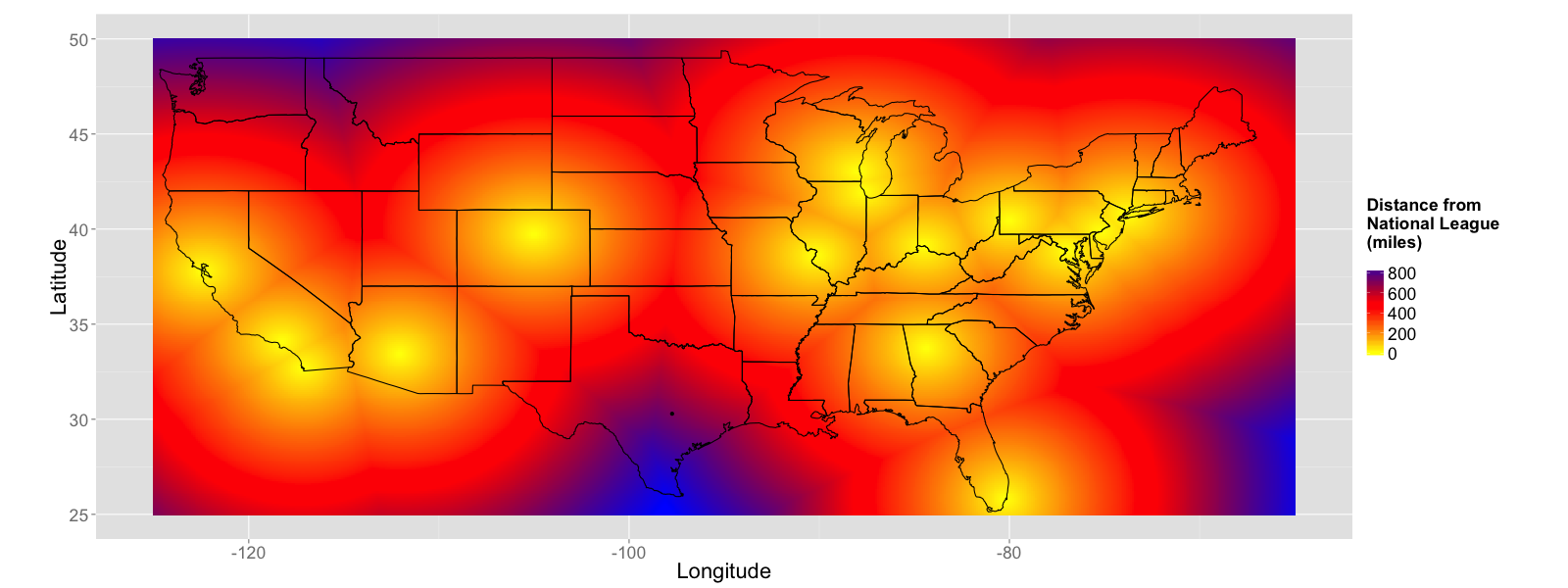
This map of the US is colored by distance to nearest NL ballpark, with Austin marked by a black dot in Texas. While the southern tip of Texas is indeed as far as you can go from the NL, Austin is actually closer than parts of Washington and Idaho, with the distance between St. Louis and Austin being comparable to the distance to the distance between San Francisco and Seattle.
For completeness sake, I also put together a map showing the AL:
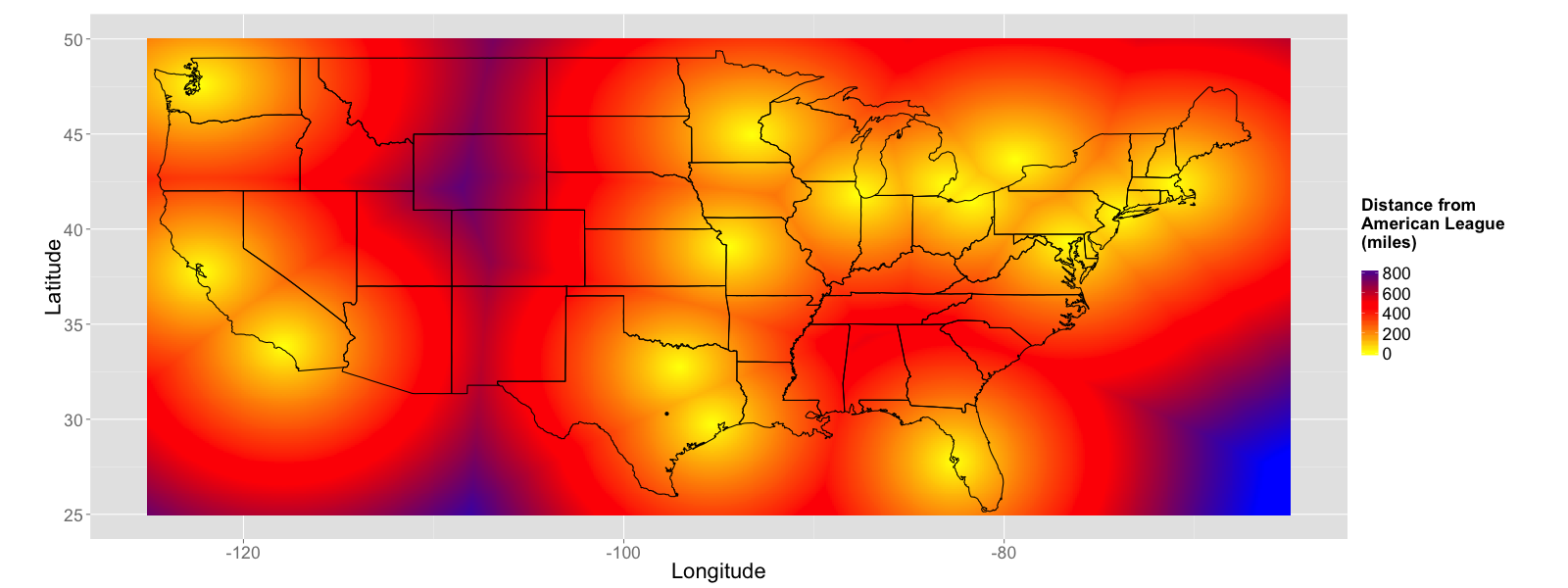
There you can see Austin, deeply embedded in heathen designated hitter country. Oh well, at least it will be easy to catch an A’s game.
Anyway, if you want to play with your own “McFurthest”-style maps, I’ve posted the code used to generate these plots over on my brand spanking new github profile.
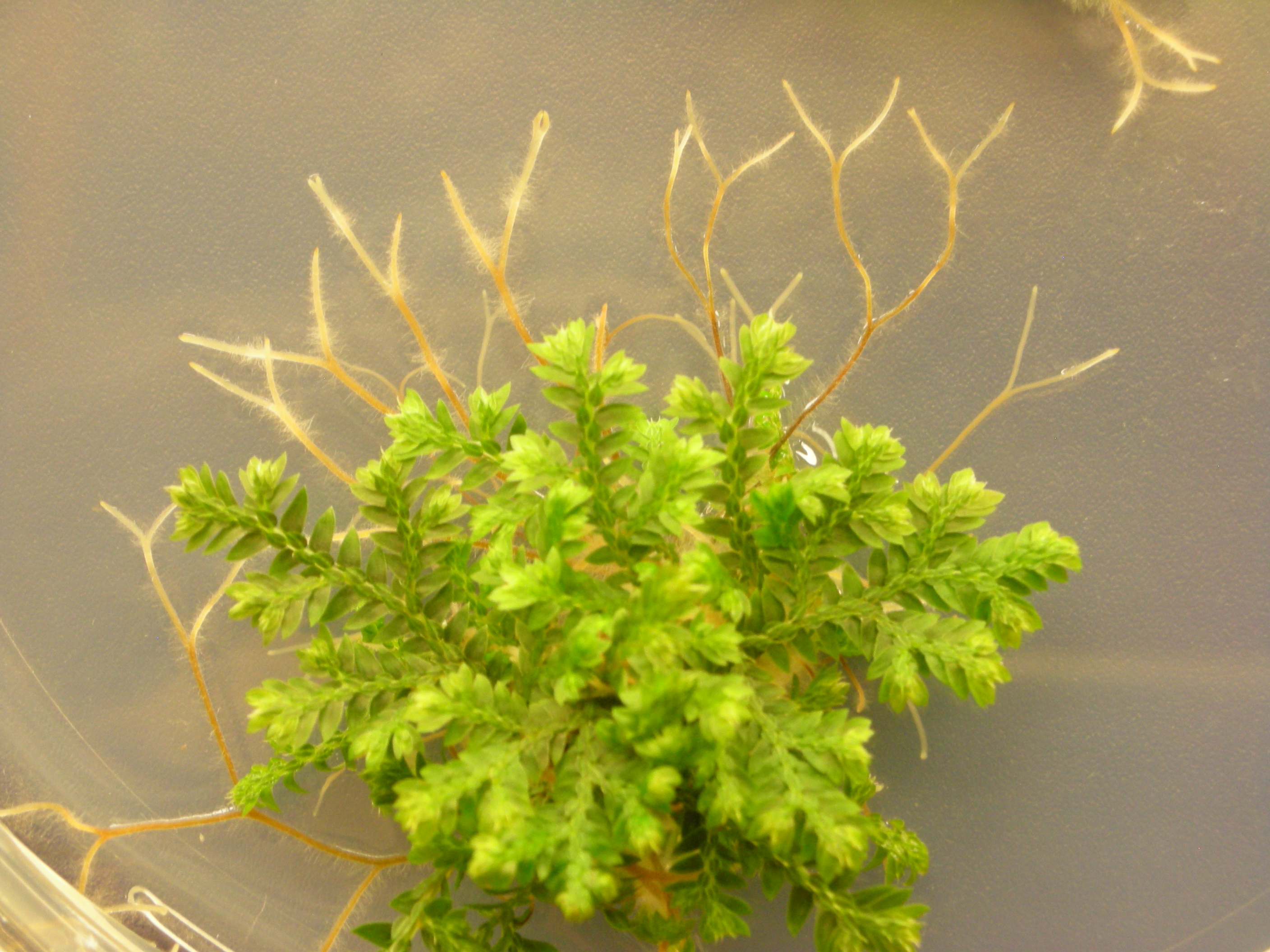
Another old photo that I have come across while going through some things. This is Selaginella moellendorffii, a plant that I spent the first couple years of my Ph.D. studying. There are a number of attributes that make this plant scientifically interesting, which I will detail in the near future, but one of my favorite aesthetic traits is the branching pattern. Lycophytes branch from the “tips” of the fronds, which are actually branch systems, with the minute scales-like structures being the leaves. Selaginella always carries out dichotomous branching, which means the tips always split into two. In the fronds, the splits are unequal (anisotomous), with one of the resulting branches being larger than the other. But the roots branch isotomously, meaning they split equally.
And the onlything more adorable than anisotomous branching is istomous branching. I mean, just look at it.
And on a paper that was submitted only 8 days after ours was first published online. It is all grown up!

Last monday we published our paper describing our gene activity in the developing seed of Arabidopsis. Thanks to everyone who worked on this. We bit off quite a bit with this project, and as a new grad student I had no idea what I was signing up for, but it was worth it. You can find the paper, in it’s entirety below. For some reason it starts the PDF on the second page of the paper, so be sure to scroll up:
Previous: Evolution of a figure
[google-map-v3 width=”350″ height=”350″ zoom=”12″ maptype=”roadmap” mapalign=”center” directionhint=”false” language=”default” poweredby=”false” maptypecontrol=”true” pancontrol=”true” zoomcontrol=”true” scalecontrol=”true” streetviewcontrol=”true” scrollwheelcontrol=”false” draggable=”true” tiltfourtyfive=”false” addmarkermashupbubble=”false” addmarkermashupbubble=”false” kml=”http://www.ryankirkbride.com/PlacesIhavenotcaughtfish.kml” bubbleautopan=”true” showbike=”false” showtraffic=”false” showpanoramio=”false”]
With the caveat that I had to be trying to catch fish at the time.
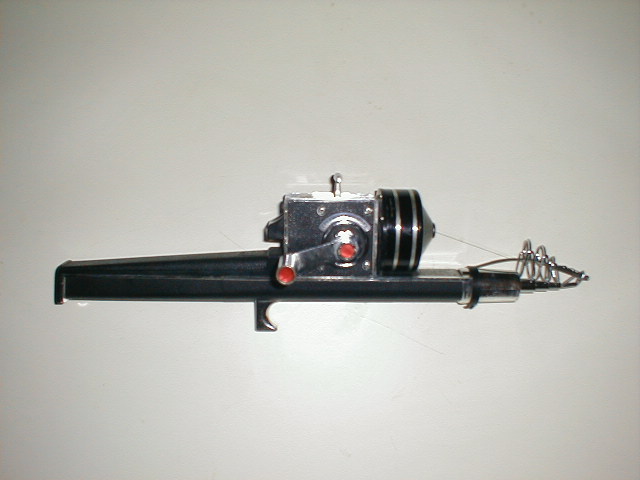
No, the last fish I caught without being shuttled on a large boat with two dozen other patrons was circa 1990 while using one of these:
I’m looking forward to moving to Austin this summer, where I will be able to add a whole new state to the places I am unable to catch fish.
 One of the side effects of being hip deep in writing your dissertation is that you run across material from your research that never made it into a publication. What gets published is usually just the tip of the iceberg.
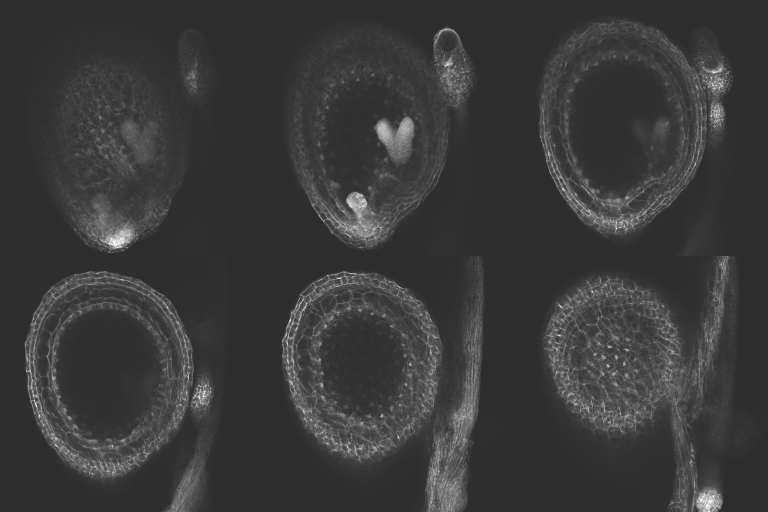
Today I ran across a set of confocal images I took through a heart/torpedo stage Arabidopsis seed. This microscopy technique allows you to take thin “optical slices” through a 3-D object without having to do any cutting. I’ve animated the set of slices I captured so you can see the progression through the seed from top to bottom. The embryo is located on the right side of the seed, and you can see the chalazal endosperm cyst at the lower left. Seeds have a lot going on inside, you just have to know how to look.
I originally pasted this on my Facebook account in response to some friends who asked my opinion on Prop 37 (The GMO labeling law in California). Some people were looking to share it more easily so it has a more permanent home. Here is my original post:
Caution, long post ahead.
The argument for Prop 37 is that people just want to know if their food contains genetically modified ingredients. How can a label be bad?
It is just information.
It seems a very measured thing to do.
This is the exact same argument used by creationists when it comes to labeling a biology text book, reminding students that evolution is “just” a theory. It is just information, how can it be bad?
I want people to know that their food is GM. I break out the numbers for people all the time. I’ve TA’ed classes that deal with this topic for several years now. I have no problem with people knowing this information. What I am against is a government mandated label. A mandated label does not merely communicate the presence/absence of something. It indicates that something is in the special select class of things WORTHY of being labeled by the government.
Go look at your pantry and read some labels. Contains peanuts. Contains salmon. Contains phenylalanine. Contains wheat. May have been manufactured on shared equipment with nuts. Those labels there because some people are endangered by those ingredients. They pose a very real risk to the sizable subset of the population who are allergic to them, and it made sense for the government to mandate labeling.
We don’t have government mandated labels like “May have been handled by redheads and/or atheists”. Why? It is just information. A portion of the populace (awful people in sheets I suspect) might like that information. But there is no good scientific reason to mandate this silly label.
Take a crop that is a product of traditional plant breeding. An average plant has 30,000 genes. You can cross that plant using traditional breeding to a wild, poisonous relative in an effort to move in a disease resistance trait possessed by that wild relative. The genome of the offspring is 50% starting plant, 50% poisonous relative. Backcross one generation, 75% of the genome is your starting plant type, the next 87.5%, the next 93.7… etc. You can backcross for generations and that number gets smaller, but not zero, you still have some of that wild relative in there. That plant doesn’t go through the USDA, FDA and EPA to make sure it is safe. No labeling required!
You can smash up a plant genome with gamma radiation (http://en.wikipedia.org/wiki/Atomic_gardening) and introduce who-knows-what kind of changes in the genome (ever eaten Star Ruby Grapefruit?). No labeling required!
You specifically drop in one gene into a genome of 30,000 genes, and then put it through orders of magnitude more testing and regulatory approval at the USDA, the FDA and the EPA. The most rigorously tested foodstuffs civilization has ever known, and never a properly documented sneeze. THAT needs to be labeled. Bwhuh?
There is a another label that exists on much of your foodstuffs. Usually a little circle with a U or a K in the middle. That is the Kosher label. It is not mandated by the government. There are private, third party certifying agencies that handle that. Why? It is very important for some people to know that the time between adding water to flour and baking their cracker was less than 18 minutes. However, there is no scientific justification for mandating a label to that effect. Government leaves it to private third parties.
If someone wants to start up a third party certification for GM-free food products, I am all for it.
Are all GM crops equal? Absolutely not. A group inserted a Brazil nut storage protein into Soybean. A protein that was an allergen. Did this soy make it to market? Nope, it was a bad idea, and the system worked. Do I think that genes introduced into grape require more scrutiny (thanks to wild relatives and the risk of outcrossing) than say maize being grown in France (where there are absolutely no close wild relatives)? Sure. Do I think they both need to be treated in the same way? No. It makes no sense. Why should they be labeled the same way?
Anyway, that is why I am against Prop 37. I don’t even want to get into the exceptions, the loopholes, the opportunities for litigious abuse, and the parallels to the ineffective Prop. 65. Anyway, if you disagree, I am happy to have a discussion on the topic.
At last the LCM paper is in fighting trim and sent off for review!
Colors now seem brighter, food tastes sweeter, and music sounds better 🙂
Fingers crossed.
Today while writing something up. I had to look up how to spell the word gobbledygook. At which point I realized that if there is a word where how you spell it really dosen’t matter, this would be it.